
Reading time: 5 minutes
Mobility in transition: decline in trips and velocity
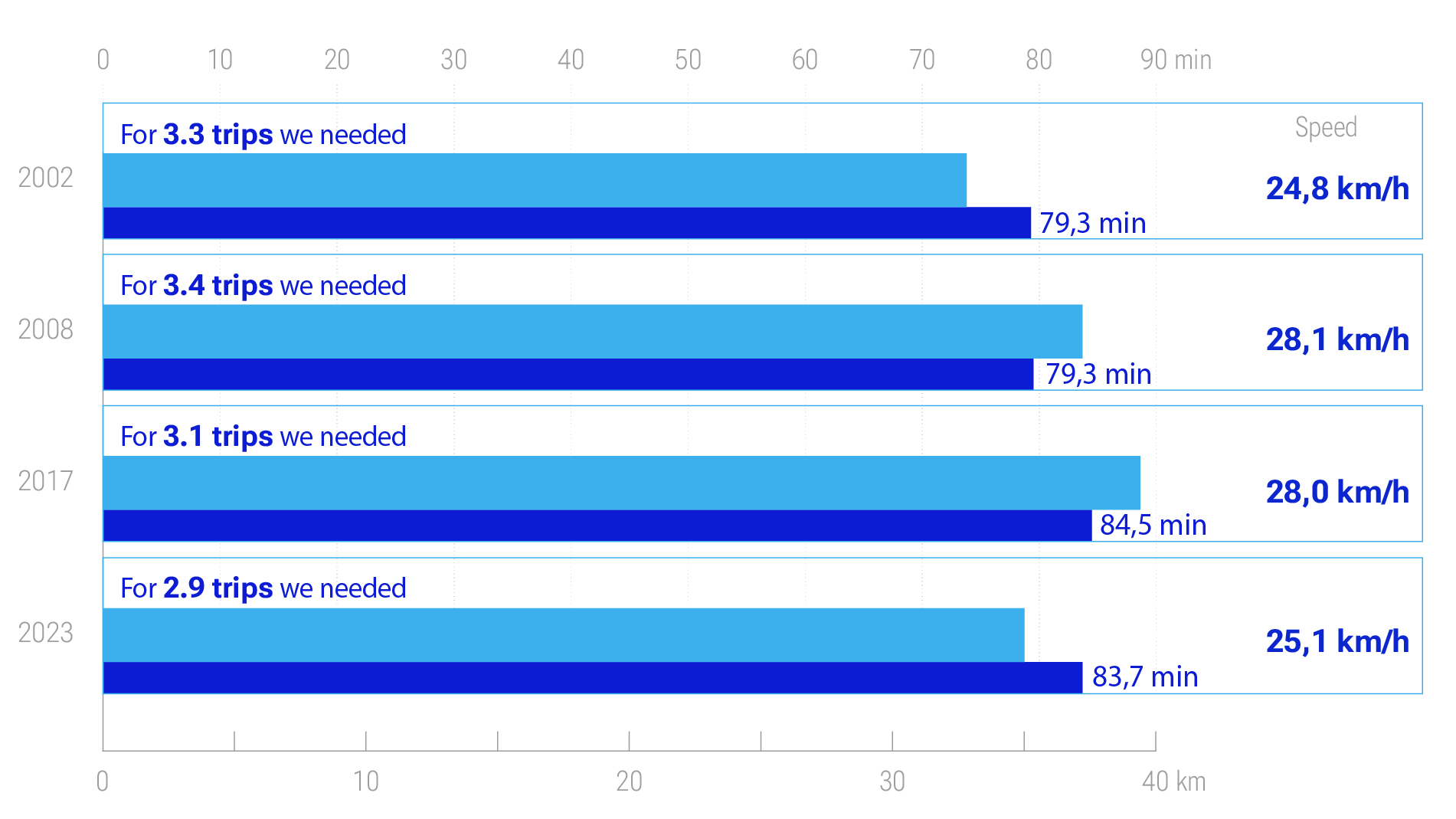
Compared to the surveys conducted in 2002, 2008 and 2017, it is evident that the German population is travelling less and slower overall. The average number of trips describes how many trips a person takes on a daily basis. While it rose slightly from 3.3 trips in 2002 to 3.4 trips in 2008, it fell to 3.1 trips in 2017 and was at 2.9 trips per day in 2023. Despite the decline in the number of trips and daily kilometres travelled, the average daily travel time with 84 minutes per day remains at almost the same level as 2017 (85 minutes), when the MiD was last taken. The reasons for the lower number of trips include working from home, online shopping and the increased bundling of trips. The almost constant travel time despite the declining number of trips indicates a slower than before traffic.
Economic status1 also influences the mobility rate: while 86 per cent of people with very high incomes are mobile on a daily basis, the figure for those with very low incomes is only 74 per cent. The gap between these groups has widened slightly compared to MiD 2017 (2017: 8 per cent, 2023: 12 per cent). This points to inequalities in the ability to participate in public life or towards a different utilization of mobility.
Where the trips have gone. Source: MiD 2002-2023
Spatial structure determines the mode of transportation
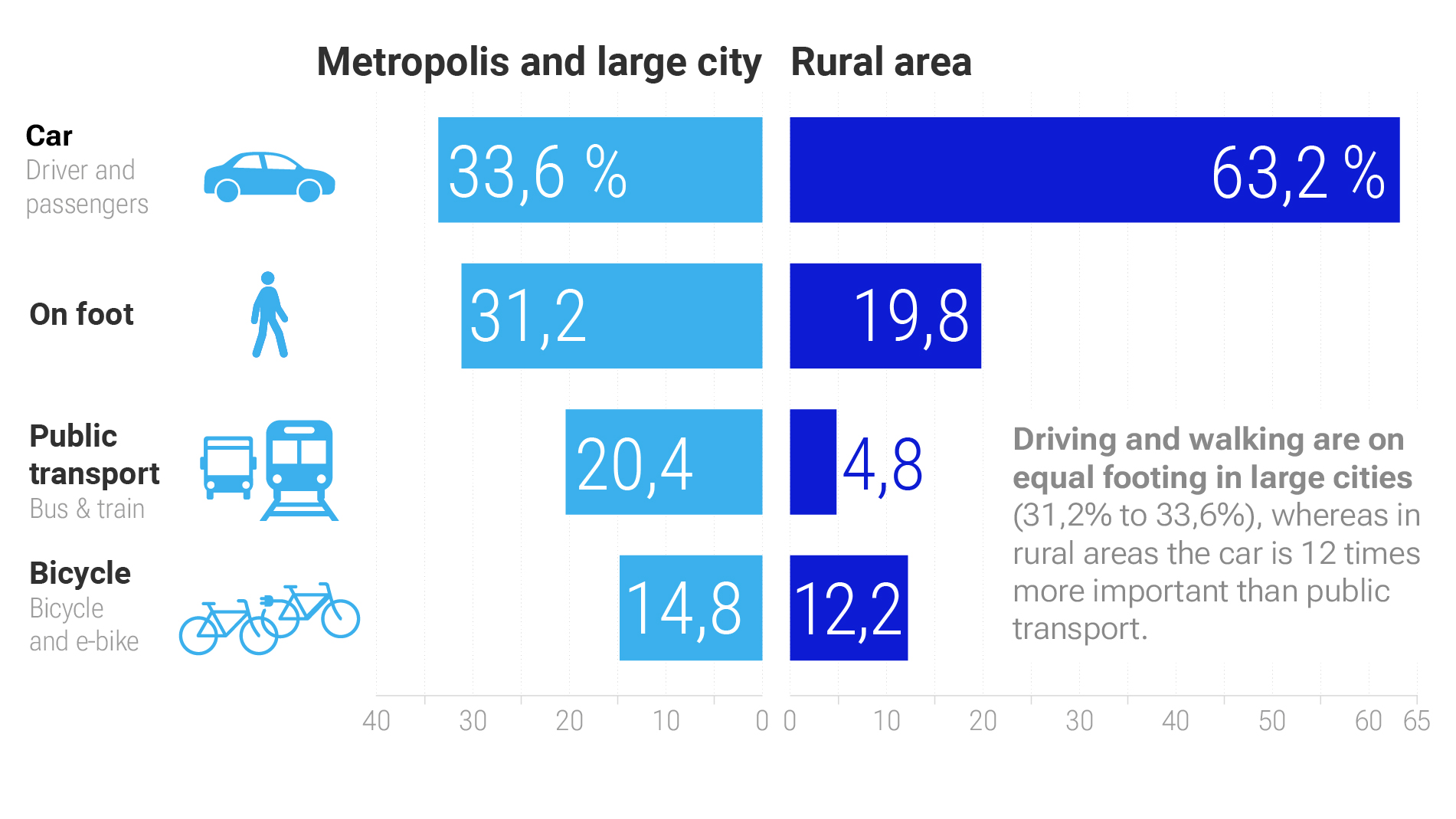
A comparison of urban and rural spaces shows that in metropolitan areas and large cities, trips taken by car and trips made on foot are almost equally distributed (33.6 per cent versus 31.2 per cent). This figure refers to the proportion of trips, not the distance travelled in kilometres.
The similarities in both forms of mobility with regard to urban spaces can be explained by the high density of residential, work and supply locations in cities, which favours short distances and encourages walking.
Public transport is, at 20.4 per cent, the third most frequently used mode of transportation in metropolitan areas and large cities. At 14.8 per cent, the bicycle (including e-bikes) is the least frequently used mode of transportation. A similar level is to be found in rural areas.
Cars clearly dominate in rural areas: at 63.2 per cent, they are the main means of transportation and are used more than twelve times as often as public transport. Around one-fifth of trips are made on foot.
Car sharing services play a particularly important role in metropolitan areas and large cities. More than one in five households now has at least one membership – almost twice as many as in 2017. At the same time, the proportion of members who hardly ever use car sharing has risen from 22 per cent in 2017 to 25 per cent in 2023.
Urban vs. rural – the mobility divide. Source: MiD 2023
E-bikes are the fastest-growing mode of transportation
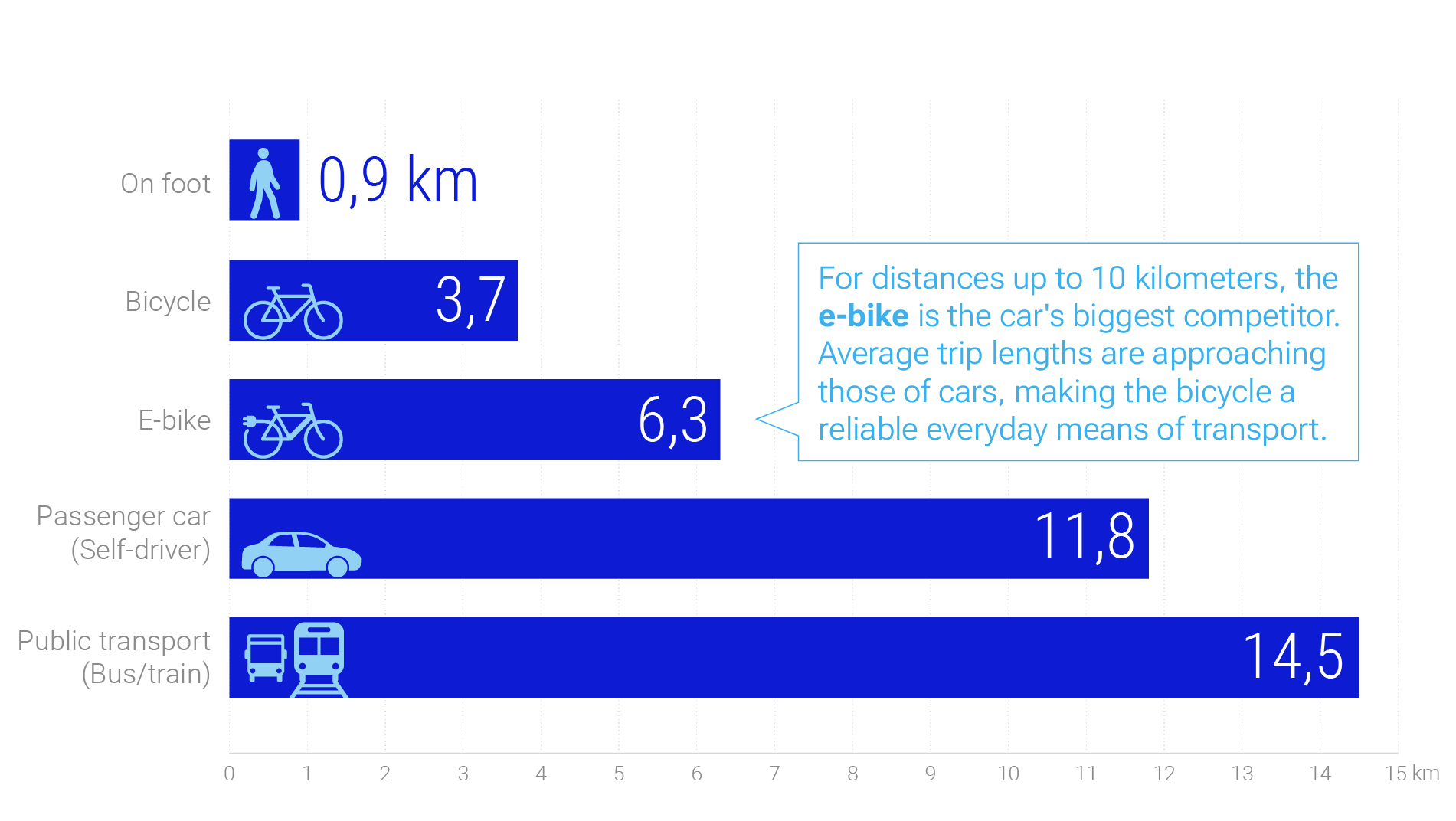
The electrification of bicycles is accompanied by significantly longer average trip lengths and strengthens the bicycle as an everyday means of transportation, even for longer distances. While conventional bicycles are used for trips of 3.7 kilometres on average, the median trip length for pedelecs (e-bikes) increases the distance travelled to 6.3 kilometres.
While in 2017 around 82 per cent of trips by bicycle were less than five kilometres, this figure was just under 80 per cent in 2023. This indicates an increase in the use of e-bikes for longer trips.
For distances of up to around ten kilometres, the pedelec is thus becoming an important substitute for the car. The average trip length is approaching that of cars (11.8 kilometres), while trips made on foot, averaging 0.9 kilometres, continue to cover mainly short distances. Public transport is predominantly used for longer everyday trips, with an average trip length of 14.5 kilometres.
E-bikes as competitors to cars. Source: MiD 2023
The total number of bicycles in German households
As in 2017’s survey, just under three out of four respondents in 2023 say they own at least one bicycle.
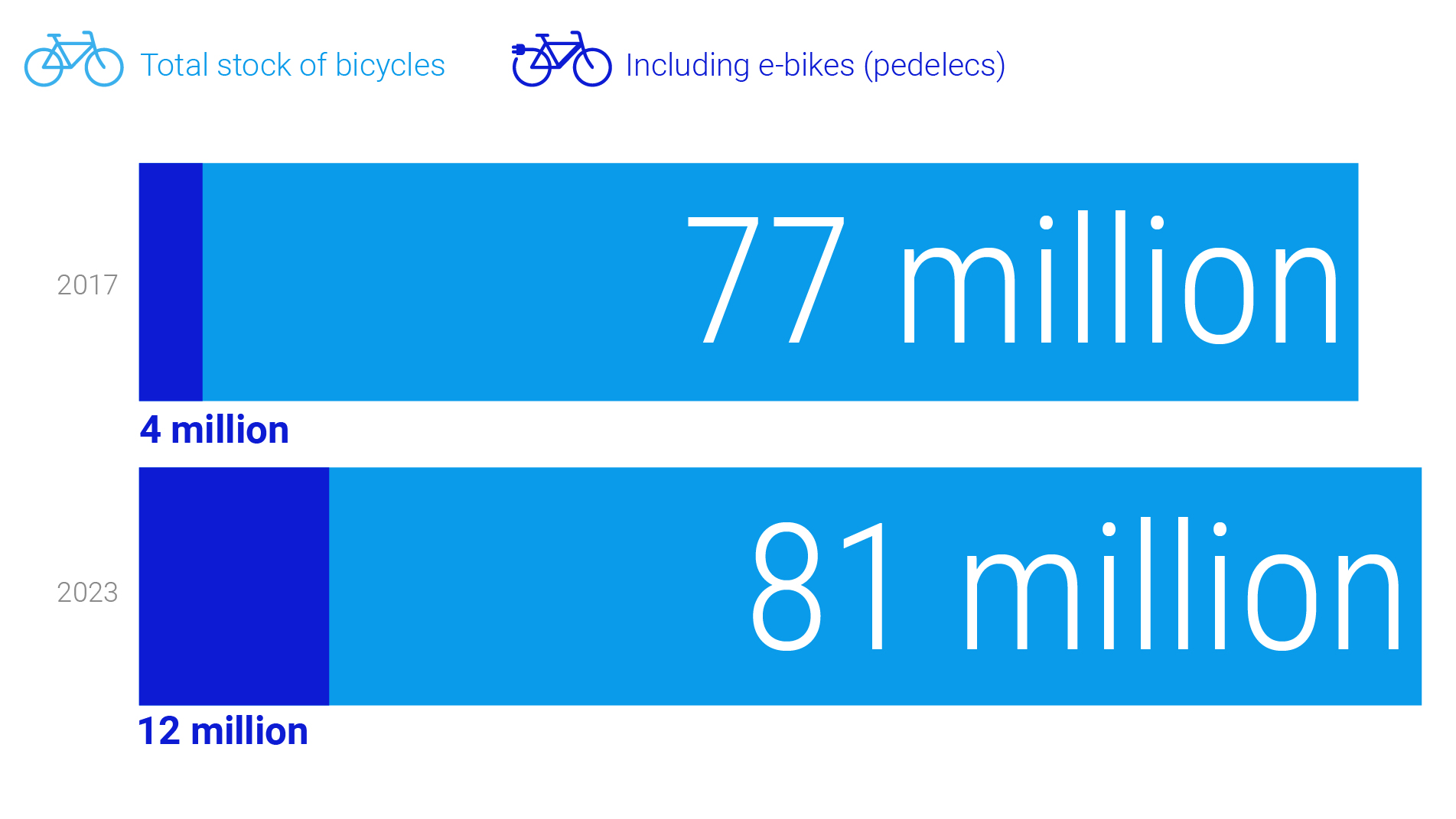
This results in a total of around 81 million bicycles in 2023, including around 12 million pedelecs. By way of comparison, in 2017 there were around 77 million bicycles, of which around 4 million were electric. 21 per cent of households now own at least one e-bike, compared to just 8 per cent in 2017. Conventional bicycles are still more common than electric bikes, with 842 bikes per 1,000 people. However, the decline in bicycle ownership since 2017 (880 conventional bikes per 1000 people) indicates that some conventional bicycles have already been replaced by pedelecs.
Although the total number of bicycles has increased, the number of bicycle owners has not, so this growth is due to multiple ownership. It is not the proportion of bicycle owners that has grown, but the number of bicycles per person.
Older people in particular are considered the main target group for e-bikes. However, since 2017, the number of pedelec users has multiplied across all age groups, with younger age groups catching up quickly. While the proportion of working-day pedelec users among the over-60-year-olds has increased by a factor of two to three, the proportion among the under-40-year-olds has increased tenfold since 2017.
Is there one bicycle for every resident in Germany? Source: MiD 2017-2023
Not moving cars instead of fast moving cars – private car ownership Stock development – occupancy rate
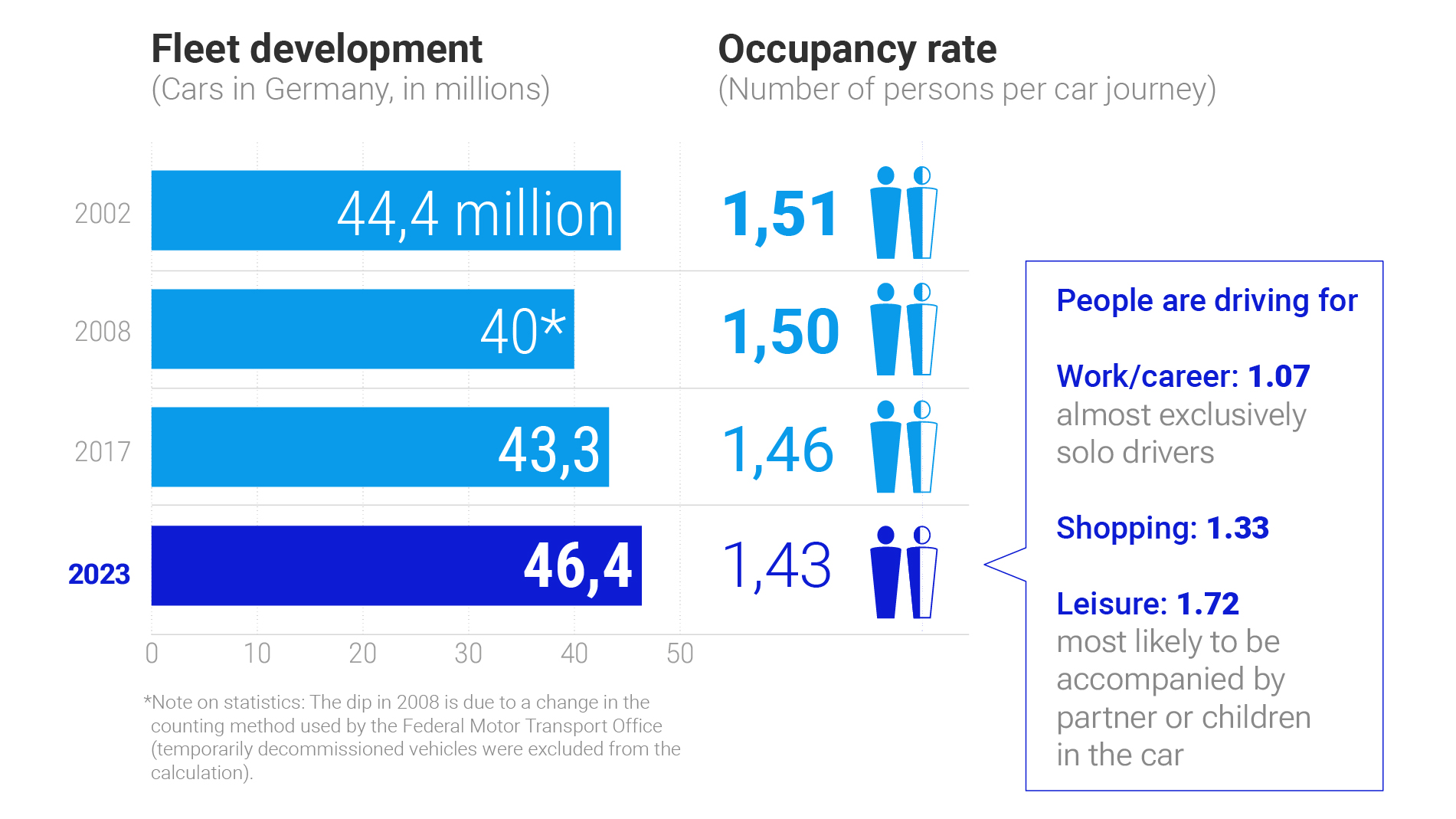
Private car ownership in Germany has risen significantly since 2002. While around 44.4 million cars were registered in 2002, the stock stood at 46.4 million in 2023. The temporary decline in 2008 (40 million) is due to a methodological change in the counting method used by the Federal Motor Transport Office (Kraftfahrt-Bundesamt): vehicles that were temporarily taken out of service were excluded from the statistics at that time.
The recent increase from 43.3 million cars (2017) to over 46 million (2023) illustrates that more and more vehicles are available. The trend towards owning one's own vehicle means that vehicles are shared less between people and usage intensities are declining.
The average occupancy rate for car trips has fallen from 1.51 to 1.43 people since 2002. It is particularly low for commuting (1.07 people), while leisurely trips are more often shared (1.72 people). On average almost half of all cars remain unused on a daily basis; in 2008, this figure was only at one third. The average driving time per day with 42 minutes in 2023, is also significantly lower than the figures for 2008 and 2017.
The decline in car use is also evident in commuter traffic: during peak hours on Tuesday and Wednesday afternoons, the number of cars on the road is almost a quarter below the 2017 level, which can be plausibly explained by the decline in commuter traffic as a result of working from home. In contrast, car demand on Friday afternoons in 2023 is slightly above the 2017 figure.
Source: MiD 2002-2023 (BMDV)
Major differences to be seen between urban and rural spaces
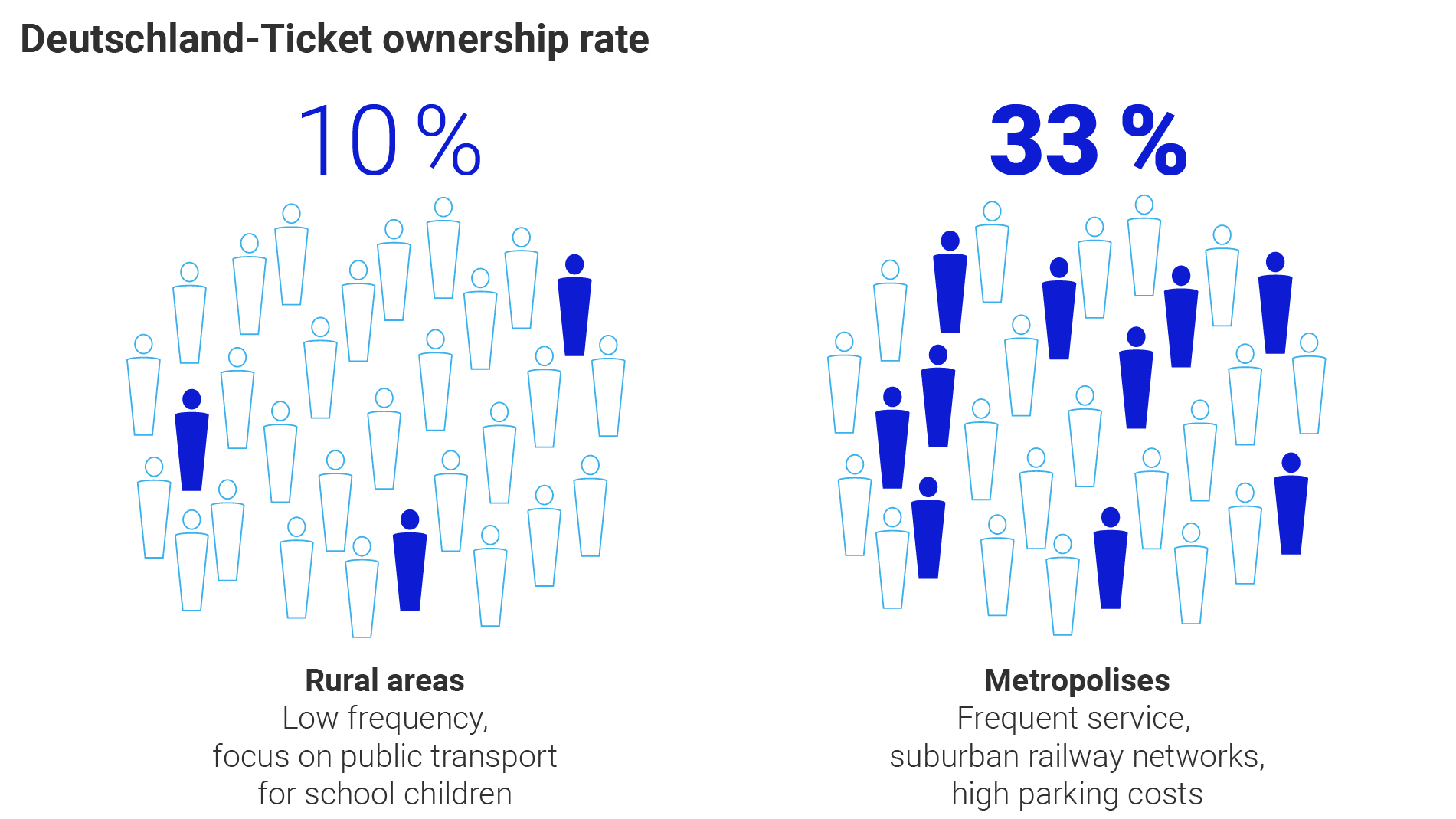
The Deutschlandticket was introduced shortly before the MiD 2023 survey. On average, 16 percent of the German population had a Germany-wide ticket during the survey period. While one in three residents in metropolitan areas and large cities had the ticket, only one in ten in rural areas did. The lower prevalence of the Deutschlandticket in rural areas is due not only to weaker network expansion and lower frequency, but also to the high availability of cars, long travel times and the low relevance of public transport in everyday life. Despite low ticket prices, public transport remains an impractical alternative for many trips.
Among those who use public transport daily or almost daily, the Deutschlandticket is the most frequently used ticket type. 58 per cent of this group were travelling with the Deutschlandticket in 2023 and 2024. The remaining members of this group largely use other subscription models. The less frequently public transport is used, the higher the proportion of people who use the cash ticket tariff. For example, 50 per cent of people who use public transport one to three days a month use single tickets or day tickets. 18 per cent of this group say that they have the Deutschlandticket despite using public transport infrequently.
How successful is the Deutschlandticket, a Germany-wide democratic access to transportation? Source: MiD 2023

1 According to MiD, the economic status of a household is derived according to the principle of equivalent income. This in turn is derived from the household's net income and household size and has become established in social and poverty research for analyses of income distribution.